































































|
Getting your Trinity Audio player ready...
|
Hamas’ October 7th Attack Plan – Analysis | AiTME #9 | An article by Avi Melamed | Podcast version powered by Ai.
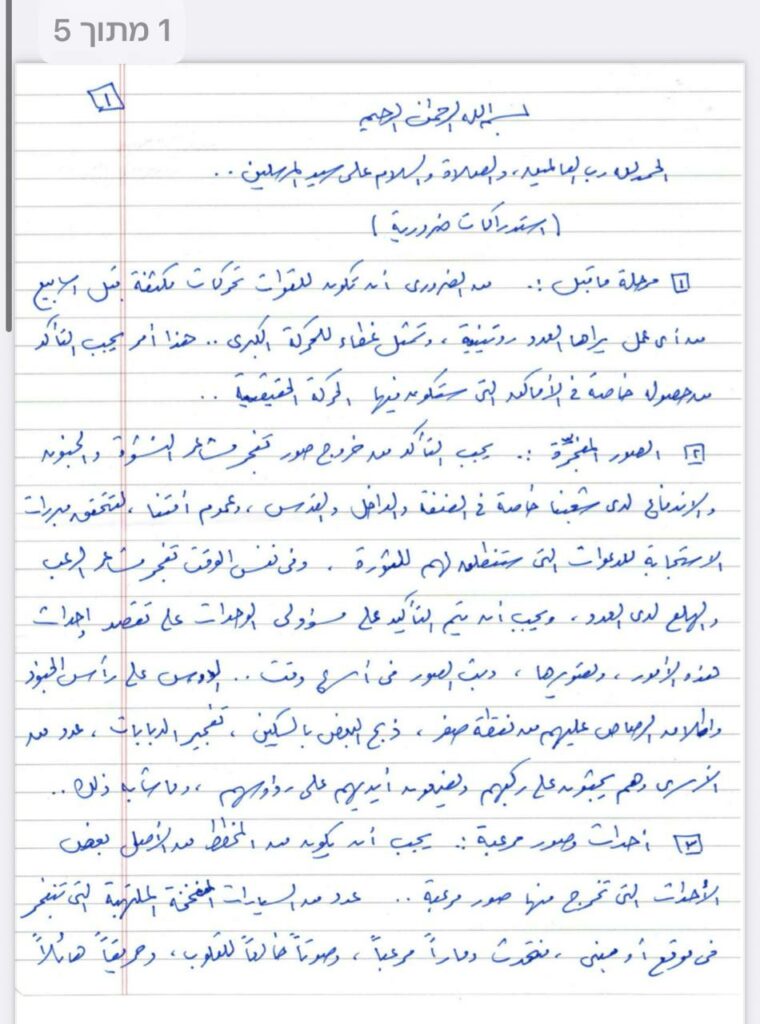
A handwritten Arabic document is once again circulating on social media. The document was originally published in October 2025 by The New York Times and appears to originate from materials seized by Israeli intelligence following the killing of Yahya Sinwar, the leader of Hamas in the Gaza Strip.
According to reporting, the document was written by Sinwar in 2022 and outlines, in broad terms, Hamas’s plan for the October 7, 2023 attack on Israel.
Avi Melamed, founder of the INSIDE THE MIDDLE EAST Institute, examined the handwritten Arabic document. Based on his professional assessment, there is no doubt that the text was written by a native Arabic speaker. In his analysis, Melamed highlights two particularly revealing sections.
In paragraphs 2 and 3, the document calls for the filming and dissemination of executions at point-blank range and the slaughter of Israeli soldiers with knives, as well as the burning of Israeli civilian communities. The stated purpose of documenting and publicizing these acts was to incite Palestinians in the West Bank and Arab citizens of Israel to join the attack, and to inflame the masses across the Arab world.
Melamed explains that these clauses—as well as the war initiated by Hamas as a whole—must be understood, among other things, in the context of the internal Palestinian power struggle between the two main Palestinian political forces: Fatah, the backbone of the Palestinian Authority, and Hamas.
Fatah was founded in the late 1950s. Its ideology was influenced by secular and socialist thought and placed at its core the goal of establishing a Palestinian nation-state, along with a political and legal system based on parliamentary legislation.
Hamas, founded in Gaza in the late 1980s, defines itself as an offshoot of the Muslim Brotherhood. The word “Hamas” in Arabic means “religious zeal,” and it is also an acronym for “Islamic Resistance Movement.” Hamas ideologically rejects the concept of the nation-state and parliamentary legislation, and instead advances the vision of a caliphate—a global Islamic entity governed by laws derived from Islamic religious law.
In 2005, Israel withdrew from the Gaza Strip and transferred full control of Gaza to the Palestinian Authority. That control, however, was short-lived. In the summer of 2007, Hamas violently crushed the Palestinian Authority’s rule in Gaza, and has governed the territory ever since. All mediation and reconciliation efforts between the Palestinian Authority and Hamas, initiated over the years by various Arab leaders, have completely failed.
Sinwar, aware of the deep hatred toward Israel prevalent in broad segments of the Arab world—a hatred that fuels a desire for revenge—hoped that publishing images of the slaughter of Israeli soldiers and the burning of Israeli communities would ignite the Arab street and Palestinian public opinion, thereby positioning Hamas as the dominant and uncontested leader of the Palestinian cause.
That expectation, however, was not realized. Palestinians in the West Bank and Arab citizens of Israel did not join the cycle of violence initiated by Hamas. Across the Arab world, rather than enthusiasm or mobilization, there was widespread and harsh criticism of Hamas—both at the official level and in public discourse—over its responsibility for the devastation inflicted on Gaza as a result of the war it launched. The war that Hamas initiated, in part to establish itself as the undisputed leader of the Palestinians, has—for now—produced the opposite outcome.
Today, Hamas finds itself facing a bleak reality, yet it will not disappear from the map, says Melamed. The central question is whether the destruction Hamas brought upon Gaza will lead Palestinians to punish Hamas and render it politically irrelevant. And that, Melamed concludes, is not a rhetorical question.
This article is also available as a Podcast: the AiTME Podcast. This Podcast was written and created by Avi Melamed, Middle East Intelligence Analyst and Founder of Inside The Middle East [ITME], an institute dedicated to apolitical, non-partisan education about the Middle East.
“This podcast is made possible by supporters like you. ITME is an independent, nonprofit institute committed to apolitical, intelligence-based Middle East education.
To support our work, visit >> https://www.paypal.com/donate/
Hamas’ October 7th Attack Plan – Analysis | AiTME #9 | An article by Avi Melamed | Podcast version powered by Ai.
If you want to have a better understanding of the news and what really drives the unfolding events… Read the latest book of Avi Melamed, INSIDE THE MIDDLE EAST | ENTERING A NEW ERA, available now >>>
Follow me on Twitter @AviMelamed; Facebook @InsideTheMiddleEast; for more Videos on YouTube https://www.youtube.com/c/AviMelamed
I can always be reached at Av*@********ed.com